The Pawnshop
Negotiation is asking the right question at the right time, holding eye contact, and letting silence do its work.
 Strategy JoeMaster Sales & Revenue Strategist
One of the most rewarding sales jobs I ever had was working in a pawnshop during the gold rush of the late 1970s and early 1980s.
Long before Pawn Stars brought pawnshops into living rooms, I was working in one during a historically significant time for the pawn industry.
I had known Richard, the pawnshop’s manager, for quite a few years. I’d sold him rare coins, and he knew me as someone who understood the coin world, was ambitious, and was quickly becoming a good friend. That led Richard to hire me as the pawnshop’s first employee.
I was hired to fill a couple of display cases with coins and effectively run a coin department, along with my other duties. I was only 19 years old, but I already had 11 years of sales experience behind me, including the experiences I’ve shared in Sales Stories #1, #3, and #4. I saw this job as a chance to build on skills I already had some experience with. The pawnshop didn’t just add to those skills—it blew them up big-time.
As business grew, more employees followed. One was a hostess, hired to greet people as they came through the door. She was the daughter of a customer who had asked Richard as a favor to hire her. She was around my age, and Richard knew she was extremely attractive. She also had a sexy Southern drawl that made her especially engaging with customers.
Then came a woman closer to Richard’s age—around her mid-thirties—who handled the tasks we didn’t: keeping the books and cleaning. Her disposition wasn’t as cheerful as we might have liked, but she got the job done. The downside was that her husband hung around all day. He was a talker, and sometimes we had to put up with his constant conversation disrupting the flow of business.
The pawnshop was owned by an accountant who had no pawnshop experience but thought it would be a great business to start. He knew Richard, who already had a strong track record managing retail jewelry stores in malls. In short, we had a pretty decent crew, and more and more people were walking through the door every day.
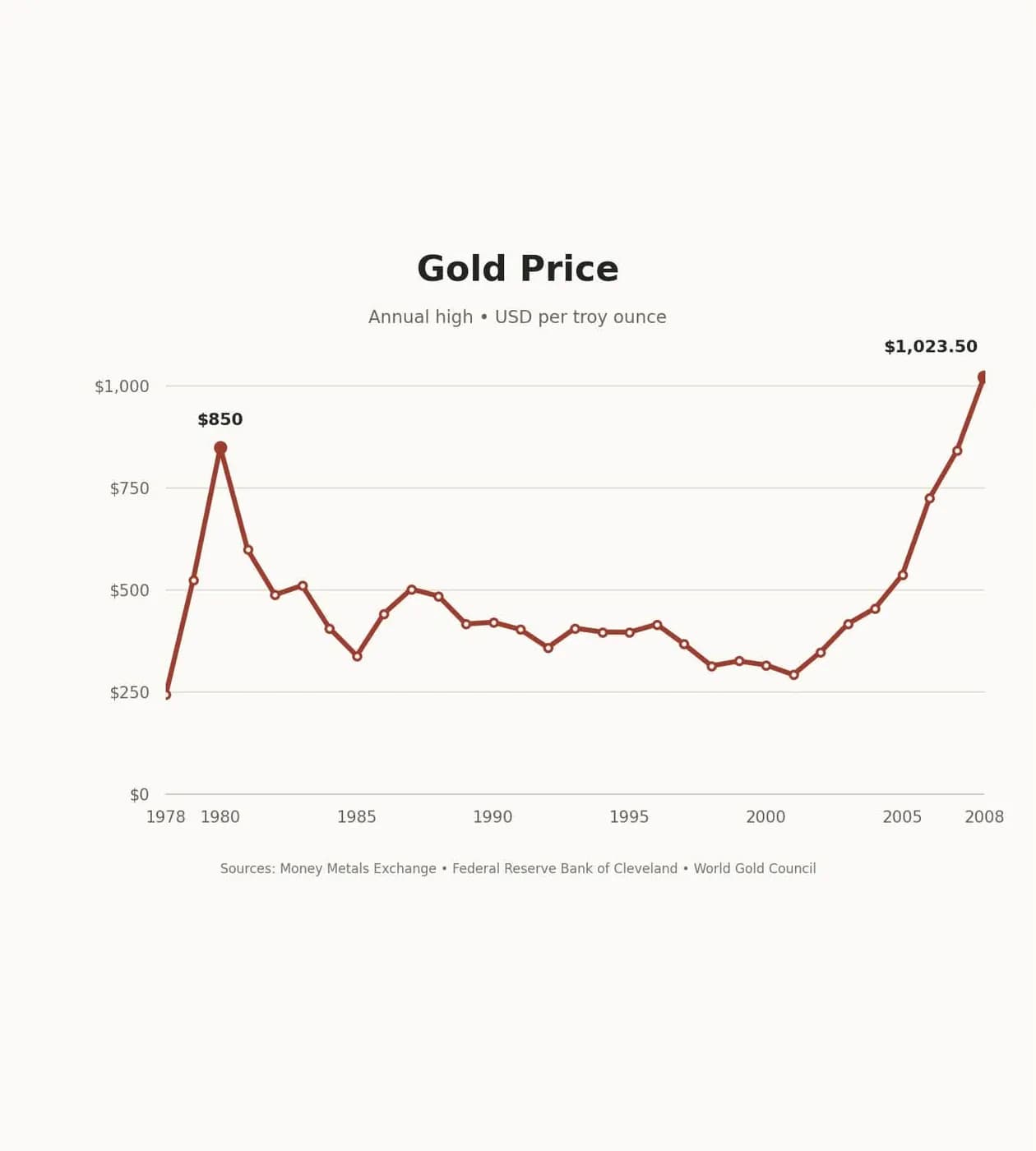
Gold was climbing fast. It reached about $200 an ounce in July 1978, then rose to $300 by July 1979 and $500 by December 1979, before peaking at $850 on January 21, 1980. That meant the market price more than quadrupled in roughly a year and a half.
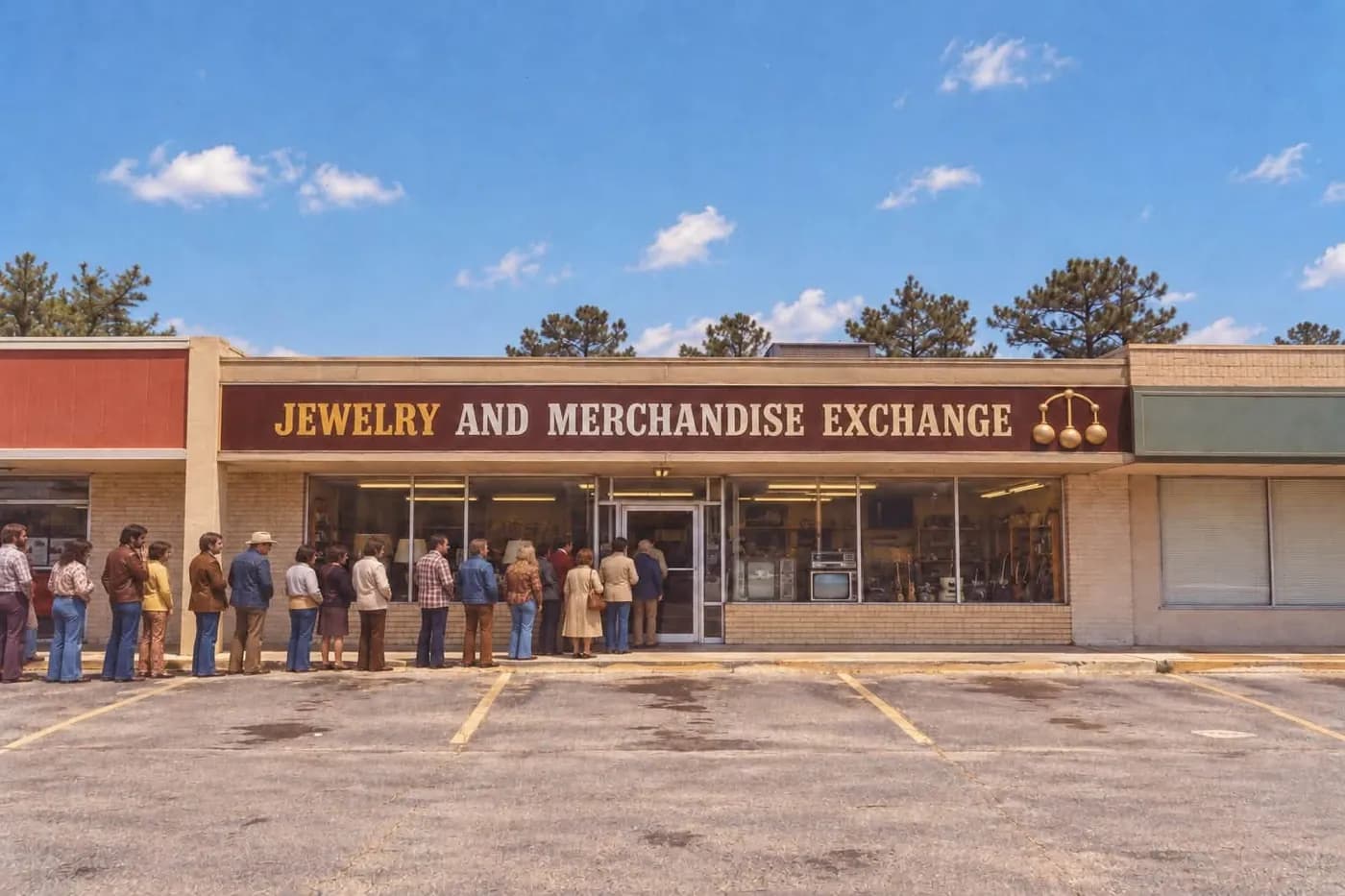
As gold kept rising at a meteoric pace, traffic increased right along with it. By around 1980, the line of people waiting to sell gold wrapped around the building and reached our front door. Some were even selling their dental fillings and teeth.
It was a slow process, and we couldn’t get to people quickly. A sale wasn’t just a matter of negotiating a price and buying the gold. We also had to fill out a card for each transaction. Once a week, the police department would pick up a stack of cards and check them against its records to see if anything had been reported stolen. If an item was stolen, the police would come to our shop and take it—and we wouldn’t be reimbursed. Insurance at the time didn’t help us recover those losses. That was one of the ways a pawnshop could lose money. There wasn’t much we could do about it, especially at a shop like ours, where we wanted everything to be aboveboard, ethical, and legal.
That paperwork helped us document every transaction, but it couldn’t make every customer interaction safe. We had several shotguns kept loaded and ready in case we needed to protect our lives. One day, a man came in to redeem an older television he had pawned. As far as we could tell, there was nothing wrong with it; it still worked. He accused us of taking the guts out of the TV. I suspected he was high. Then he reached toward the waistband of his pants. Within seconds, two employees were there with shotguns, ready to defend themselves in case he had a gun. Even when we checked IDs and kept detailed records, we couldn’t know what someone might be dealing with or how they might react. Some customers had troubled pasts or were going through difficult times. Many others were good, hardworking people who had simply fallen on hard times. Helping those customers when we could was one of the more rewarding parts of the job, and it was the side of the business I focused on.
There was also a more lighthearted part of our informal security setup. Richard had a large friend about his age who would stop by, sit in a chair—or sometimes on top of a stereo cabinet—and tell stories. He wasn’t an official security guard and didn’t carry a gun, but he was so big that people assumed he was there to protect the shop. We didn’t pay him; he was Richard’s friend and enjoyed hanging around. His visits gave us plenty of stories, laughs, and good times, and we always enjoyed having him there.
The pawnshop also held a federal firearms license through the Bureau of Alcohol, Tobacco and Firearms (ATF), and the recordkeeping requirements for guns were strict. I would sometimes buy a gun from the shop, take it to a shooting range or out into the woods, and later sell it back. That was how I learned about firearms and how to shoot accurately.
“Negotiation is asking the right question at the right time, holding eye contact, and letting silence do its work.”
Gold, silver, and jewelry weren’t the only things we took in. We bought plenty of sound equipment, including early stereos and reel-to-reel tape machines, and we built up a nice collection of guitars. I knew very little about those categories at first, but I learned a lot at the pawnshop. I also learned that electronic components could fail after equipment had been stored in a hot environment, leaving us with merchandise that was difficult to sell or worth less than we expected. Between stolen items we couldn’t recover and other merchandise losses, we took some serious hits. That was exactly why we felt pressure to protect our margins and do everything we could to make a profit.
To add to that, all of us had to take a PSC, or Psychological Stress Evaluator. It was basically a lie detector test, meant to let the accountant-owner know if anyone was stealing from the company. To my knowledge, all the employees passed. Again, it was a good bunch.
We turned down a lot of questionable deals. I remember one time a teenager came in trying to sell what looked to me like a rare 1916-D Mercury dime. We passed on it because the situation seemed questionable, and we knew the police would review the paperwork we had to file. We passed on a lot of things that didn’t feel right. It was better that way, and it helped keep our losses down.
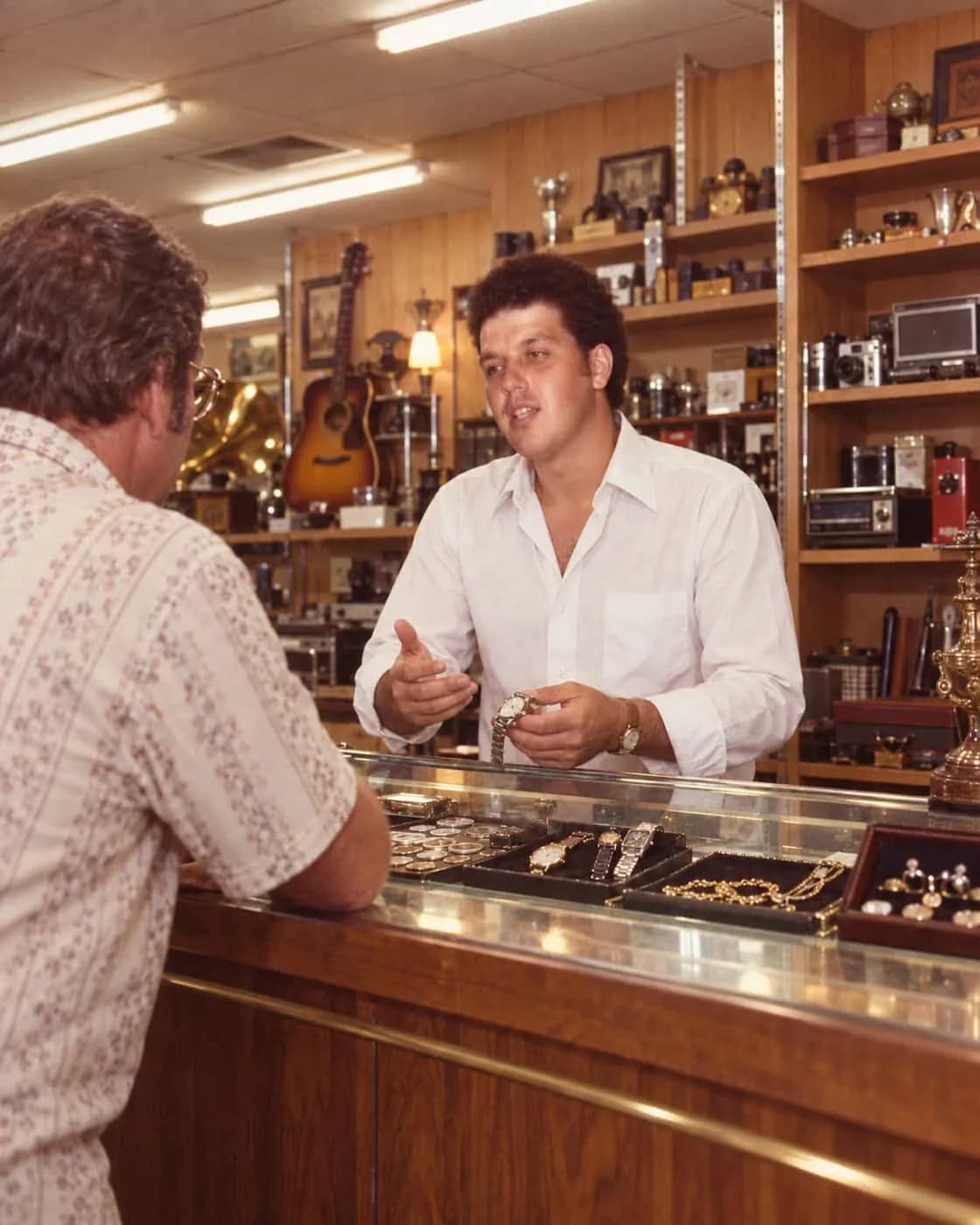
The skill I learned most about was negotiation—and I enjoyed it. I also learned how much eye contact and timing mattered: when to speak, when to pause, and when to let the silence do its work. Sometimes, early in a conversation, a prospect would wrestle with me: “You’re the one buying it. What would you pay for it?” I’d tell them, “I’d pay as little as I could. But if you give me a number to start with, I can let you know right away whether I can do it or not—and save us the back-and-forth.”
I understood why it was crucial to let the seller name the first price. If we named a number first, we might offer more than the seller had in mind and give away money before we even knew what they wanted. Letting them speak first gave us a starting point and a better sense of their expectations. Their first number wasn’t automatically our offer; it was information we could use to guide the conversation.
The pawnshop also taught me to examine an item closely and notice anything that could affect its value—its age, rust, missing parts, or anything that didn’t work. Those details gave us specifics to discuss and could give us leverage in a negotiation. Later, when I was selling services, I used careful questions in a different way. I would politely ask prospects how their process was working and whether they were satisfied with it. Their answers often revealed problems or gaps we could help fix.
Those negotiation skills helped me throughout the rest of my sales career, especially later when I took on partners and started businesses.
For ordinary merchandise, we would generally try to buy at about half of what we thought we could sell it for in the shop. An item that cost $100 new might be worth only $30 or $40 used, so we might try to buy it for around $20. That could rub people the wrong way, but we had to stick to the formula to cover our expenses.
One purchase still stands out. I once bought a one-carat engagement ring for $20—the pawnshop’s record for best purchase. It wasn’t a high-grade diamond; it had plenty of flaws, blemishes, and carbon. But it was still a full carat, and even then, $20 was a very good price.
Today, I regret that deal. If I could go back in time and give that person more money, I would.
Unlike what you sometimes see on Pawn Stars, where someone may tell a customer an item is worth more than the customer is asking, we didn’t have that luxury. Our owner’s instructions were to go for the lowest price possible. We had to have the killer instinct to get there.
At the far end of the strip center, we also operated a second location under the name General Merchandise Brokers. When a customer and I couldn’t get to an agreement, I might mention that they could try the other shop a little farther down the road. We had an intercom between the locations, so I’d let the employee there know someone was coming and what price we had discussed. That way, the conversation could continue without the customer having to start over. Sometimes, after considering it, the seller decided to accept the offer at the second location. In the late 1970s, we believed we needed every legitimate opportunity to protect the business from the losses we were taking. We did our best to negotiate honestly and not lie to people, but looking back, I can see how a seller who had already spent time negotiating might feel worn down by the process. That was how we handled it then, and I want to be candid about it without dressing it up as a clever trick.
I enjoyed the negotiation itself, but I didn’t always enjoy having to push for the lowest price possible. It felt spiritually wrong. I was young, I followed orders, and I also felt some pride when I managed to get an item at the lowest cost.
Gold’s peak marked the beginning of the end. Richard and the accountant-owner both believed it would reach $1,000 an ounce, but there was nothing concrete to substantiate that target. It was a belief. When gold turned downward, a lot of the shop’s money was tied up in gold, and the value of that inventory kept falling. That created a cash-flow problem: money committed to gold could not be used to buy other goods that might sell quickly and bring cash back into the business. The longer we held the gold as its price declined, the less flexibility we had to purchase fresh merchandise and keep money circulating. Within two mornings of the January 21 peak, the London price had dropped to $650 an ounce. It fell to $480 by March 17, 1980, and below $285 by February 1985. Gold did not fix above $1,000 on the London afternoon benchmark until March 14, 2008—about 28 years later. By then, it was too late for us. I left the pawnshop around 1980 and never looked back.
About 20 years later, I spoke with Richard again. He told me it had taken a good 15 years to get out from under the drop in gold prices, and that he regretted holding on. Richard may have been older than me, but I sensed we were in a bubble, and leaving when I did was the right decision for me. The whole experience had driven him crazy, but he eventually found spirituality and became a minister.
The pawnshop sharpened my sales instincts and taught me lessons I carried through the rest of my career:
Some of the lessons I learned
- 01Study an item carefully, learn its condition and value, and keep learning unfamiliar categories.
- 02Listen closely, let the other person speak first, and use eye contact, questions, timing, and silence thoughtfully in a negotiation.
- 03Ask prospects how their current process is working and whether they are satisfied; their answers can reveal problems we may be able to solve.
- 04Never accept a sales job unless its pitch represents a genuinely good value for the prospect—100%.
- 05In the jobs that followed, I wanted more than success limited to the number of people who happened to come through the door.I wanted the opportunity to reach prospects I might never otherwise meet and the possibility of unlimited income. Much of my sales career after that point included that kind of outreach, and at times my income felt unlimited.
- 06I also learned not to accept a sales job without a commission component.Negotiating a good deal gave me real satisfaction, but over time that was outweighed by the excitement of earning commissions without a fixed ceiling.
- 07In a major deal, watch for early signs that the conditions which made it attractive are changing.The gold collapse taught me to recognize the beginning of the end and make my departure moves appropriately.
- 08Don’t be afraid to try innovative ideas that could lead to greater profit and success.Opening a second pawnshop on the same block was one example. Later, an innovative idea would lead to the greatest earnings of my life and benefit me for years. That’s the subject of a future Sales Story.
- 09Learn to work with the handful of people around you every day and avoid turning every disagreement into a conflict.I can’t say we were the best team I ever worked with, but we were a team. The others supported Richard and me as the lead deal makers.
- 10Remember that careful records and honest intentions cannot prevent every loss, and that a confident belief is no substitute for evidence.
- 11Treat people fairly.Helping hardworking customers through difficult times was the most rewarding part of the job.