The Five Amigos
50 new agents. One tough product. Five salesmen left standing.
 Strategy JoeMaster Sales & Revenue Strategist
It was the late 1980s, long before online job boards, LinkedIn, and email applications.
For those of us in sales, Sunday had a ritual.
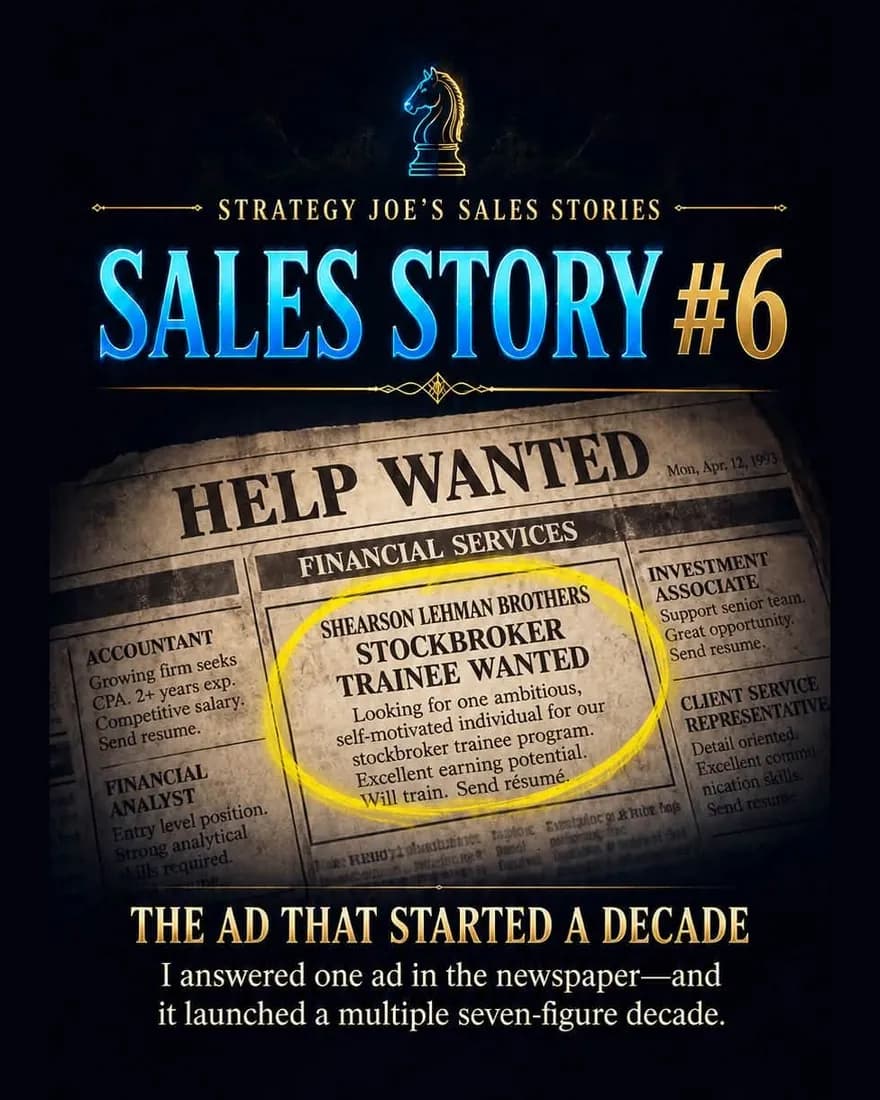
We pulled the Help Wanted section from the newspaper and folded it into a square that highlighted the Sales column. With a pen or highlighter in hand, we marked every opportunity that looked promising.
That folded piece of newspaper became our call list for Monday morning.
Some salesmen did not even wait until Monday. They started calling on Sunday, hoping someone might answer the telephone and give them a chance to get in first.
Speed mattered even then.
Keith Wood Agencies understood exactly where ambitious salespeople were looking.
The company placed large recruiting advertisements aimed at nurses, construction workers, salespeople, and almost anyone willing to leave an old career behind and become an insurance agent.
They were not searching only for experienced insurance agents.
They were searching for people who could sell.
That advertisement brought me into the group health insurance business. It also brought in four other men whose lives had followed very different roads.
At first, we were simply five strangers in a room filled with people searching for a new opportunity.
But none of us arrived empty-handed.
All five of us had entrepreneurial and sales experience. We understood how to approach people, gain their attention, explain an idea, and ask for a decision. That experience probably contributed as much to our production as anything the company taught us.
My friend Keith was already in his mid-30s. He had spent his career selling capital equipment to printing shops—an industry he had known nearly his entire life.
But the printing business was going through a slow period.
Keith did not particularly want to sell insurance.
For that matter, neither did I.
At that point in our lives, however, we had to do something—and it needed to pay well.
Sometimes a career begins with a grand plan.
Sometimes it begins because the bills keep arriving.
I was around 30. At that age, I somehow believed everything in my life would change for the worse once I reached that magic number.
Thirty sounded old.
Looking back now, all I can do is laugh.
The recruiting room was filled with people from nearly every walk of life. There was a housekeeper, a nurse, a carpenter, and many others who had never worked in sales.
On Monday mornings, that crowd grew until, at its peak, more than 50 newly licensed insurance agents filled the room.
The company offered them the same possibility it offered us: learn the presentation, receive some leads, and build a new career selling group health insurance.
Anyone can succeed with the right drive and the right training.
We believed that then, and I still believe it now.
But experience teaches you to recognize certain things before anyone says a word.
At the end of that first week, the manager asked everyone who had written more than $10,000 in business to stand.
The five of us stood up.
We looked around the room at one another—and then at everyone who remained seated.
In our heart of hearts, we knew that the housekeeper, the nurse, the carpenter, and most of those without previous sales experience would probably never succeed.
It was not our place to tell them that. Anyone could have surprised us. Given enough determination and the right training, one of them might have become the best producer in the room.
We simply did not see that drive in most of them, and the necessary training was not there.
During the nearly five decades since, I have rarely seen someone enter sales without previous experience or meaningful training and succeed.
People who have never tried sales have never lived it. They have not experienced the rejection or learned how to hear no, get up the next morning, and make the next call as if yesterday never happened.
Even now, I do not know whether that resilience can be taught—or whether some part of it has to be innate.
What I do know is that the five men standing that Friday had already learned it.
That was the moment we first recognized one another.
It was the beginning of the five amigos.
We carried the same presentations. We sold the same policies. We attended the same meetings. Pegasus—the company’s symbol—appeared everywhere. It was on the trophies, medals, and awards handed out to the top producers.
We saw one another twice a week.
On Mondays, we picked up our leads.
In the beginning, those leads were fresh.
We traveled throughout Florida, going wherever the leads took us. We made our presentations, wrote the business, and moved on to the next prospect.
Our closing percentages were close to 100%.
“The product was temporary. The brotherhood lasted.”
We were not merely making a living.
We were making money.
We stayed in luxury hotels as we traveled around Florida. We ate well. We enjoyed the road. We were being recognized, earning awards, and building confidence with every sale.
Then Friday came.
We returned for the weekly meeting, compared our numbers, told stories from the road, and stood together when the manager asked who had written more than $10,000.
Those became our $10,000 Fridays.
That number did more than measure production.
It identified us to one another.
We were five men with different histories and personalities, but we shared the same appetite for the sale. We understood the work, the pressure, the rejection, and the satisfaction that came when a prospect finally said yes.
Nobody needed to explain those feelings to the other four.
We had all lived them.
That common experience formed a bond quickly.
We became friends.
We became competitors in the best sense of the word. When one of us produced a large number, it pushed the rest of us to do more. When one of us had a rough day, the others understood exactly what that meant.
We laughed together, traveled together, compared notes, and helped one another make sense of a business we had entered almost by accident.
The company had recruited five salesmen.
What it created was a brotherhood.
The good times did not last forever.
After about six months, the leads began to change.
The fresh prospects were disappearing. In their place came the B-backs—people who had already told another agent to come back later.
By the time a lead reached us, the prospect might have already seen four or five agents and received four or five different quotes.
They knew the presentation.
They knew the questions.
They knew exactly what we were going to say before we said it.
The closing percentages that had once approached 100% began falling.
The luxury hotels disappeared.
Eventually, we could barely afford a Motel 6.
That was sales reality giving us an education no company meeting could provide.
A great salesperson still needs opportunity.
A great presentation still needs a prospect who has not heard it five times already.
And even the strongest group of producers cannot continue pulling fresh sales from leads that have been worked until there is almost nothing left.
There was another problem.
What we were selling as group health insurance was an inferior product—pretty much an indemnity policy.
It could be sold.
We proved that.
But selling a product and building something permanent are two very different things.
The ability of the five amigos helped carry that product much farther than the product could ever have carried us.
The money was real.
The awards were real.
The Pegasus trophies and medals were real.
But the greatest thing we gained had nothing to do with commissions, policies, or recognition.
We found one another.
The insurance opportunity eventually came to an end.
The five amigos did not.
The product was temporary.
The brotherhood lasted.
That experience taught me that careers sometimes bring people into your life for reasons that have very little to do with the career itself.
We had answered advertisements because we needed work that paid well.
We had entered an industry that neither Keith nor I particularly wanted to enter.
We had driven throughout Florida chasing leads, first sleeping in luxury hotels and later wondering whether we could afford the Motel 6.
We had watched the $10,000 Fridays slowly disappear as fresh leads became B-backs that had already heard the same pitch from four or five agents.
But through all of it, we had built something that did not depend on lead quality, closing percentages, or the company remaining in business.
We had built friendships.
Fortunately, one of the amigos in our five-amigo crowd had already researched another insurance company.
So when the end came, we were out of work for only about a week.
That is another lesson about surrounding yourself with experienced, resourceful people.
One opportunity may disappear, but someone in the group is already searching for the next one.
The Pegasus stopped flying.
The five amigos kept moving.
Some of the lessons I learned
- 01Previous sales experience matters—not simply because it teaches someone how to present and close, but because it teaches a person how to live with rejection.
- 02Anyone can succeed with the right drive and training, but neither drive nor training should be assumed merely because someone answered an advertisement.
- 03I still do not know whether resilience can be completely taught.Some people seem to arrive with it already inside them.
- 04Fresh leads can make an average salesperson look great.Exhausted leads can make a great salesperson question himself.
- 05Never confuse early success with permanent success.Markets change, lead quality declines, and products disappear.
- 06The people standing beside you may become more valuable than the opportunity that brought you together.
- 07Surround yourself with resourceful people.When one door closes, someone may already know where the next door is.
- 08Jobs end.Products disappear. Genuine friendships can last a lifetime.